
Most of us believe that lasting behavioural change begins with a simple decision. We resolve to improve our sleep, change our eating habits, quit smoking, manage chronic pain, or face public speaking with newfound confidence. When motivation is running high, this conscious choice feels entirely achievable.
However, a familiar pattern often takes over. The moment stress returns or an old trigger appears, our body reacts before our conscious mind even has time to process the situation. Despite our best intentions, the old behaviour resurfaces, leaving many people to blame themselves for a perceived lack of willpower or discipline.
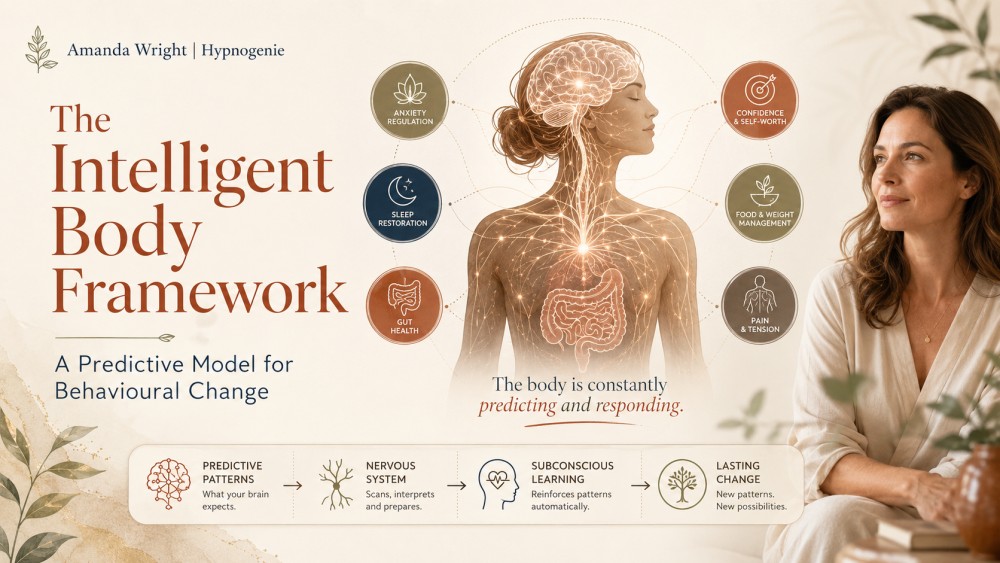
But what if the issue isn’t a lack of strength? What if your body and mind are simply executing exactly what they have been trained to do? This is the core philosophy behind The Intelligent Body Framework—a predictive model designed to explain how subconscious patterns form, why they persist, and how they can be effectively updated for permanent change.
How Your Body Predicts Your Reality
Your body does not merely react to the world around it; it actively predicts it. Drawing on past experiences, emotional memories, environmental cues, and physical sensations, your nervous system is constantly asking itself what is likely to happen next and how it can keep you safe.
These rapid predictions happen well beneath your conscious awareness, shaping your emotions, thoughts, and subsequent behaviours. While these automated responses are often helpful for navigating daily life efficiently, the nervous system can sometimes get stuck predicting danger or discomfort in situations that are no longer genuinely threatening. When this happens, old, unhelpful patterns become deeply locked in.
Why Automatic Habits Feel Invincible
Many of our daily habits are not conscious choices, but rather deeply learned physical responses. For instance, a person might logically want to stop emotional eating, but their body has learned that food equals immediate comfort during times of stress. Similarly, someone may want to remain calm during a presentation, but their nervous system automatically predicts a threat the moment they stand before an audience.
Because these responses are pre-stored patterns, simply knowing what you should do is rarely enough to change them. When a conflict arises between a logical conscious thought and an automatic physical prediction, the body’s deeply ingrained prediction almost always wins.
Shifting Focus from Mind to Body
One of the most vital realisations of this framework is that behavioural change is a physical process, not just a mental one. Habits and anxieties carry full-body states, such as a racing heart, shallow breathing, or intense physical cravings.
To break these cycles, we must work with the mind and body in tandem. Instead of fighting symptoms using willpower alone—which easily fails when we are tired or overwhelmed—we need to update the underlying prediction at the subconscious level.
Transforming Patterns with Clinical Hypnotherapy
This is where clinical hypnotherapy becomes a powerful tool. By accessing the subconscious mind, hypnotherapy allows the body and nervous system to safely experience new, calmer predictions. Whether you are navigating weight management, transitioning away from GLP-1 medications, managing IBS, or trying to improve your sleep, this approach helps rewrite old associations.
Ultimately, your body is incredibly intelligent. Its patterns were built to protect you based on past experiences. By updating these subconscious predictions rather than fighting them, you can finally guide your body into understanding that change is safe, allowing new, positive habits to unfold naturally.