
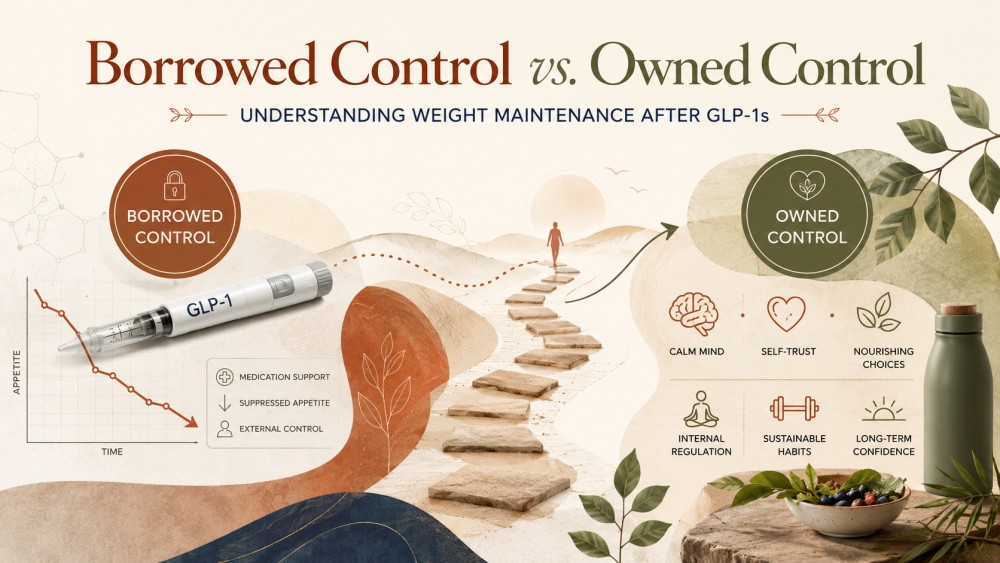
The introduction of GLP-1 medications like Ozempic, Wegovy, and Mounjaro has fundamentally shifted how we approach weight management. For many Australians, these treatments provide a sense of relief that has felt out of reach for years—quietening constant hunger, reducing persistent “food noise,” and making portion control feel entirely natural. When the daily mental battle around food disappears, making healthy choices suddenly feels achievable.
However, a critical question arises for everyone on this journey: What happens when you reduce your dosage or stop the medication entirely? To understand how to maintain your progress long-term, it helps to look at the difference between borrowed control and owned control.
What is Borrowed Control?
Borrowed control is the structural support provided by something outside of yourself. In this case, the medication is doing the heavy lifting by chemically regulating your appetite and dampening cravings.
This external support is an incredibly valuable tool. It breaks long-standing, frustrating habits and proves to your mind and body that change is possible. The breathing room it provides can build massive momentum and confidence.
The limitation, however, is that borrowed control is temporary. When you transition off the medication, your biological baseline will naturally shift back. Appetite can return, and old eating prompts may reappear. This isn’t a personal failure or a failure of the medication; it simply means the external support has done its job, and it is time to hand the reins over to an internal system.
What is Owned Control?
Owned control is the internal regulation that stays with you for life. It doesn’t rely on strict rules, sheer willpower, or a medical script. Instead, it is built on emotional steadiness, behavioural consistency, and self-trust.
Developing owned control means you can:
- Listen to your body’s actual hunger cues without feeling anxious.
- Notice a craving without feeling a compulsory need to act on it.
- Recognise comfortable fullness and stop eating naturally.
- Navigate high-pressure situations—like dining out at restaurants, holidaying, or unwinding after a stressful day—without automatically turning to food for comfort.
True maintenance isn’t about being perfect; it’s about having a reliable psychological toolkit. Willpower is a finite resource that runs out when you are tired or stressed. Owned control, by contrast, rewires the subconscious patterns that drive your habits automatically.
Shifting Your Identity for Long-Term Success
Sustainable weight maintenance requires looking beyond just calories and appetite. Many of our habits are tied to our nervous system—using food as a reward, a stress reliever, or a coping mechanism for exhaustion.
This is where clinical hypnotherapy and behavioural change support become essential elements of the transition process. By working with the subconscious mind, you can quieten the fear of weight regain, build confidence in your body’s signals, and establish a resilient “reset response” for when life gets throwing challenges your way.
The ultimate goal of moving from borrowed to owned control is an identity shift. You stop viewing yourself as someone permanently fighting against their biology, and start operating as someone who naturally knows how to maintain a steady, healthy lifestyle with calm confidence.