
Hypnotherapy is a focused, relaxed state of attention guided by a trained clinical hypnotherapist that helps the subconscious mind shift unhelpful patterns. Across Australia, it is used to support issues like anxiety, sleep, chronic pain, weight, and stubborn habits.
You have tried willpower, the late night self help reels, maybe even a few therapy sessions, and the same patterns keep coming back.
If that sounds familiar, you are probably wondering what is hypnotherapy really, and whether it could finally shift things, like a growing number of Australians are starting to ask.
The global hypnotherapy market sat at around USD 12.16 billion in 2023 and is projected to reach USD 70 to 81 billion by 2030, so clearly something about it is working.
Forget the swinging watches and stage shows, this guide cuts through the noise so you understand what hypnotherapy actually is, how it works in your brain, what it can help with, and whether it suits you.
So What Exactly Is Hypnotherapy?
Hypnotherapy is a guided therapeutic process that uses focused attention and deep relaxation to help you access the subconscious mind and create change.
It is not sleep, it is not mind control, and it is definitely not magic, even if pop culture keeps trying to sell it that way. You stay aware the whole time, you keep your values, and you are an active participant in the work, not a puppet on a string.
The style practiced at HypnoGenie in Perth is solution oriented hypnotherapy, which means sessions are built around the outcome you actually want, like better sleep or calmer mornings, rather than digging through the past for the sake of it.
According to the Australian Hypnotherapists Association, Australia’s peak hypnotherapy body since 1949, clinical hypnotherapy is a legitimate, structured therapy delivered by trained practitioners who follow a strict code of ethics.
Clinical Hypnotherapy vs Stage Hypnosis
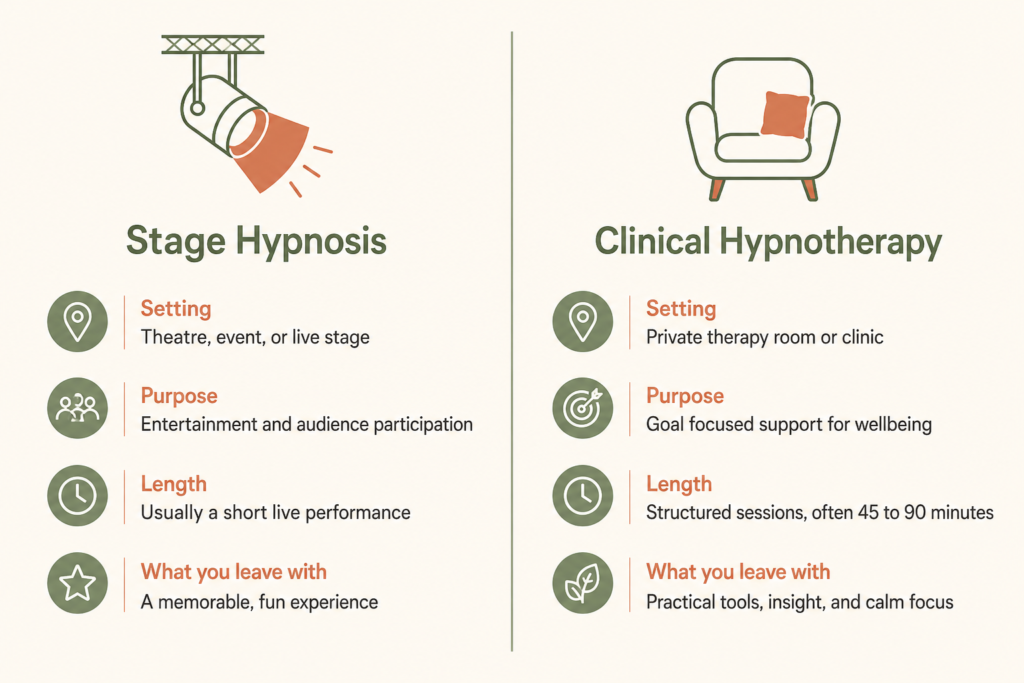
Stage hypnosis runs on entertainment value. Volunteers are screened beforehand for high suggestibility, the lights are bright, and the script is built around laughs.
The participant agrees to play along with a performer whose job is selling a show, and the whole thing wraps in a few minutes per person.
Clinical hypnotherapy works in a quiet room with two people, a clear goal written down before the session even starts, and a structure that runs roughly 60 to 90 minutes.
You sit or recline, talk through what brought you in, ease into a relaxed focus, hear targeted suggestions tied to your goal, and come back to full alertness with a short debrief.
Throughout, you can hear the traffic outside, you can speak, you can open your eyes, and if the smoke alarm went off you would be on the street faster than the practitioner.
The control myth is the loudest one in the room, and it dies the moment you have actually sat through a session. You hear, you choose, you walk.
How Does Hypnotherapy Actually Work in Your Brain?

The conscious mind handles logic, analysis, willpower, and the running commentary in your head reading this right now. It is fast, deliberate, and tires quickly.
Underneath, the subconscious runs everything you stopped thinking about a long time ago:
- Reaching for a cigarette the moment stress hits
- Biting your nails through a tense email
- The 3am wake up that will not budge
- The anxious thought loop before every meeting
- Eating the whole packet and barely remembering opening it
Those patterns live in the back office. Willpower keeps trying to argue with them at the front door, which is why “just stop snacking at night” almost never sticks past Wednesday.
Picture your mind as an office. The receptionist out front is the conscious mind, sceptical, asking who you are and why you are here, screening everything that walks in.
The back office is the subconscious, where decisions get filed and acted on. Hypnotherapy walks past the receptionist with the right ID so the message lands where it can actually change something.
What Brain Scans Reveal About Hypnosis
The brain imaging backs this up. In a 2017 study published in Cerebral Cortex, Stanford researchers led by Dr. David Spiegel scanned 57 people during hypnosis and found three consistent changes.
Activity dropped in the dorsal anterior cingulate, the brain’s worry and self-monitoring centre, so the constant background chatter quietened down.
Connections strengthened between the prefrontal cortex and the insula, which is the brain-body bridge that lets you read and regulate physical sensations.
And links softened between the prefrontal cortex and the default mode network, the region behind the “is this actually working” self-talk.
Those shifts explain why a suggestion delivered in hypnosis settles in and shapes how you act the next day.
What Can Hypnotherapy Help With in Australia?

Most people who walk into a hypnotherapy session are not chasing some exotic treatment, they have already tried the obvious stuff and want something that actually reaches the layer where the problem lives.
Across Australia, including a steady stream of clients from Perth and wider WA, hypnotherapy is increasingly used alongside GP care and counselling rather than in place of either, filling the gap where talk therapy and willpower keep stalling.
Here is where HypnoGenie tends to help most:
- Anxiety and stress. Calms the racing thoughts and the constant alert mode that keeps your shoulders up around your ears, so your nervous system gets a reset.
- Sleep problems and insomnia. Trains the mind to wind down on cue and breaks the 2am loop of checking the time and panicking about how tired you will be tomorrow.
- Weight loss and emotional eating. Works on the trigger behind the snack, not the snack itself, so the fridge stops being a stress response.
- Quit smoking and other habits. Targets the subconscious link between the trigger (a coffee, a phone call, finishing a meal) and the cigarette, vape, or whatever the habit happens to be.
- Chronic pain and medical hypnosis. Used alongside your medical team to change how the brain processes persistent pain signals, often reducing the volume without touching the cause.
- Women’s health concerns. Supports issues like fertility stress, hormonal anxiety, menopause symptoms, and the mental load that piles on top of all of it.
- Public speaking and confidence. Quiets the voice that says “everyone is going to know,” so you walk in steady and walk out without replaying it for three days.
If your concern is medical, hypnotherapy works best as a complement to your GP, specialist, or psychologist, never as a replacement for proper diagnosis or prescribed treatment.
Is Hypnotherapy Safe and What Happens in a Session?

Yes, hypnotherapy is safe for most healthy adults when delivered by a qualified clinical hypnotherapist.
A typical session runs 60 to 90 minutes and involves a relaxed conversation about your goal, a guided induction into focused relaxation, therapeutic suggestions tied to that goal, and a gentle return to full alertness.
Inside a HypnoGenie session, the first 15 to 20 minutes look like a regular chat. Amanda asks what brought you in, what you want to feel or do differently by the end of the work, and any history that matters.
From there, you settle into a recliner, your eyes close, and a guided induction walks you into a state of deep focus and physical relaxation.
The therapeutic work happens in that state, using imagery, suggestion, and language built directly around the goal you set in the first half of the session.
After 20 to 30 minutes of that, Amanda eases you back to full alertness, you have a short debrief about what came up, and you leave with a clear next step, often a short audio for daily listening at home.
If you live with psychosis, epilepsy, or certain heart conditions, or you are currently being treated for a serious mental health concern, check with your GP or specialist before booking, so the hypnotherapy work runs alongside your existing care rather than ahead of it.
Will I Be Asleep or Out of Control?
You hear every word. You can shift in the chair, scratch your nose, clear your throat, answer a question, open your eyes, or stand up and walk out whenever you want. Hypnosis is a state of focused attention, closer to being absorbed in a great film, where you are still aware of the seat under you while fully invested in what is on screen.
Your values stay yours throughout. Any suggestion that conflicts with what matters to you, your morals, or your sense of safety simply will not land, and your subconscious will either reject it outright or bring you back to full alertness on its own. The control myth tends to fade fast once you have actually felt the state for yourself.
How Many Sessions Will I Need and How Do I Find a Good Hypnotherapist?
Most issues see meaningful change in 3 to 6 sessions, while focused habit work like quit smoking can sometimes resolve in 1 to 2. The actual number comes down to how long the pattern has been running, how clearly you can name the outcome you want, and how willing you are to do the short between-session work most clinical hypnotherapists send you home with.
Choosing the right practitioner matters more than choosing the right number of sessions. Hypnotherapy in Australia is self regulated, so the title “hypnotherapist” alone tells you very little. Before you book, run your shortlist through this checklist:
- Membership with a recognised professional body. Look for the AHA (Australian Hypnotherapists Association), ASCH (Australian Society of Clinical Hypnotherapists), or PHA (Professional Hypnotherapists of Australia). Members of these bodies sit on the HCA National Register, follow a code of ethics, and are required to keep up ongoing supervision and professional development.
- Proper clinical training. A weekend NLP certificate is not clinical training. You want a Diploma of Clinical Hypnotherapy or equivalent, plus continuing education, plus practical case hours.
- A clear intake process. A good practitioner will ask about your goal, your history, your medications, and any conditions that need a GP sign off before they touch a single induction.
- A free initial chat. Twenty minutes on the phone before you commit any money should be standard. If a clinic only offers a paid first session, that is your answer.
For Perth readers, Amanda Wright at HypnoGenie ticks each of those boxes and offers a free 20 minute telephone consultation, so you can talk through your goal and decide whether the fit is right before you book a full session.
Conclusion
Hypnotherapy is a safe, evidence informed therapy that helps the subconscious mind work with you on the patterns running underneath your day, instead of against you.
If you have read this far, you already have a goal in mind. Book a free 20 minute telephone consultation with Amanda Wright at HypnoGenie, talk it through, and find out whether hypnotherapy is the right fit. Call 0400 517 470 or email amanda@hypnogenie.com.au.
Hypnotherapy in Australia: FAQs
How much does hypnotherapy cost in Australia?
Most clinical hypnotherapy sessions in Australia run between $150 and $250, with Perth practitioners typically sitting in the $130 to $210 range. Quit smoking and weight loss programs are usually packaged from around $375 to $600, which covers one to two sessions plus a personalised audio.
Does private health insurance cover hypnotherapy?
Medicare does not cover hypnotherapy. Some private health funds offer partial rebates under extras cover when your practitioner is registered with a recognised body like the AHA or ASCH, so call your fund with the practitioner’s provider number before you book.
Can hypnotherapy be done online?
Yes. Online sessions work well for most goals if you have a quiet room, headphones, and a stable connection. HypnoGenie offers video sessions for clients across regional WA, the eastern states, and Australians overseas, with the same length and structure as in person work.
Can everyone be hypnotised?
Most adults can. Willingness to relax, a clear goal, and trust in the practitioner matter more than any natural talent, and the depth of trance you reach has very little to do with how well the suggestions land.